Glossary
We chase waterfalls because we enjoy it and it's fun, so, here are some fun bits of information...Cataract
(n) Waterfall, from the greek Καταρράκτης (waterfall).Cataractology
(n) The study of waterfalls, from the greek Καταρράκτης (waterfall) and λογίᾱ (study of).Cataractologist
(n) A person who studies waterfalls, see cataractology for etymology.Cataractophilia
(n) The love of waterfalls, from the greek Καταρράκτης (waterfall) and φιλία (love of).Cataractophile
(n) Lover of waterfalls, see Cataractophilia for etymology.Cataractophobia
(n) Extreme or irrational fear or dislike of waterfalls, from the greek Καταρράκτης (waterfall) and φόβος (fear or morbid fear).Cataractophobe
(n) Person with an extreme or irrational fear or dislike of waterfalls, see Cataractophobia for etymology.Waterfall Forms
Generally speaking, natural waterfalls come in two types - plunge and cascade. Everything else that appears in the "form" is there to narrow down the shape of the waterfall for better identification. This is, of course, a human conceit based on our need to put a label on everything. No waterfall gives a hoot about the labels that we apply to them.
Dams fall into a category of their own: Some are a simple concrete wall, others still have at least some remnant of the waterfall that existed before the construction of the dam.
Plunge
A plunge waterfall pours over a lip and drops straight down without making contact with the rock behind it. Of course, there are exceptions to this rule (there always are) such as terraced falls.
Cascade
Unlike a plunge waterfall, a cascade maintains contact with the ground over which it is flowing for all or most of its descent. Many cascades begin or end with a plunge.
Classic
A classic waterfall is one where the maximum width of the flow is approximately equal to the height of the waterfall.
Curtain
A curtain waterfall is one where the maximum width is noticeable wider than the height of the waterfall.
Ribbon
A ribbon waterfall is one where the height of the waterfall is noticeably greater than its maximum width.
Terraced
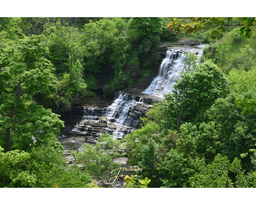 A terraced waterfall is one where several segments of the waterfall are separated by "Terraces" or level
steps. For example, Albion Falls is a Terraced Classic Cascade.
A terraced waterfall is one where several segments of the waterfall are separated by "Terraces" or level
steps. For example, Albion Falls is a Terraced Classic Cascade.
Complex
Talus